Neural Machine Translation (NMT) is a sophisticated AI approach that looks at whole sentences—not just individual words—to produce a translation. It’s a complete departure from older methods. Instead of just swapping words, NMT first works to understand the complete idea, including context and nuance, before it even starts translating. The result is a much more natural and human-sounding output.
What Is Neural Machine Translation in Simple Terms
Let’s use a classic example: “It’s raining cats and dogs.”
If you translate that phrase word-for-word into Spanish, you get “está lloviendo gatos y perros.” Anyone who speaks Spanish would just be confused. This is exactly the kind of trap older machine translation systems fell into. They worked in isolated chunks and completely missed the bigger picture.
Neural Machine Translation doesn’t make that mistake. It uses a complex system modeled after the human brain, known as a neural network. This network reads the entire source sentence first, building a rich mathematical model of its actual meaning. It figures out the relationships between words, the grammar, and the intent behind the phrase.
Only after it has a solid grasp of the full context does it begin generating the translated sentence, word by word, in the new language. This holistic method is why NMT can deliver translations that aren’t just accurate but also fluid and appropriate for the situation.
Why NMT Matters for Your Website
This is a massive leap forward, especially for any business trying to reach a global audience. The benefits are clear and tangible.
- Superior Quality and Fluency: NMT outputs sound natural and read smoothly. This preserves your brand’s unique voice and professionalism, no matter the language.
- Contextual Accuracy: It can decipher ambiguous words or idioms (like our “cats and dogs” example) by looking at the surrounding text. This helps avoid the awkward, and sometimes embarrassing, errors that plagued older systems.
- Continuous Improvement: NMT models are constantly learning from massive datasets. This means the technology gets smarter and more precise over time, all on its own.
At its heart, NMT is about moving from simple word replacement to genuine meaning transfer. It’s the difference between a clunky dictionary and a skilled interpreter who captures the spirit of the message, not just the words.
For WordPress site owners, this powerful technology is no longer out of reach. It’s the engine running under the hood of modern translation plugins, capable of handling everything from blog posts to intricate e-commerce product descriptions with impressive speed and precision.
Understanding how NMT works is the first step to using its power to take your content global without sacrificing quality. To see these principles in action, you can explore how advanced AI video translator technology operates, which breaks down a similarly complex process. This gives you a deeper look into how AI can interpret and recreate nuanced communication across languages.
How NMT Grasps Meaning and Context
Think of a skilled human interpreter at a global conference. They don’t just translate word for word. Instead, they listen to an entire idea, internalize its meaning, and then skillfully rebuild that thought in a new language. Neural Machine Translation (NMT) works on a remarkably similar principle, using a clever architecture known as an encoder-decoder model.
First up is the encoder. This part acts like the interpreter’s ear. It takes in the whole source sentence—let’s say, “El perro corre rápidamente por el parque”—and condenses its complete meaning into a compact numerical representation. This isn’t just a simple list of words; it’s a rich vector that captures everything from grammar to the relationships between words and the sentence’s overall point.
Then, the decoder steps in, acting as the interpreter’s voice. It takes that dense numerical summary and starts crafting the translation in the target language, one word at a time. The magic here is that it constantly refers back to the entire encoded meaning as it constructs the new sentence. This ensures the final output—”The dog runs quickly through the park”—flows naturally and makes sense in context.
This process diagram shows how NMT ingests a full sentence, uses AI to understand it, and then generates a fluent translation.
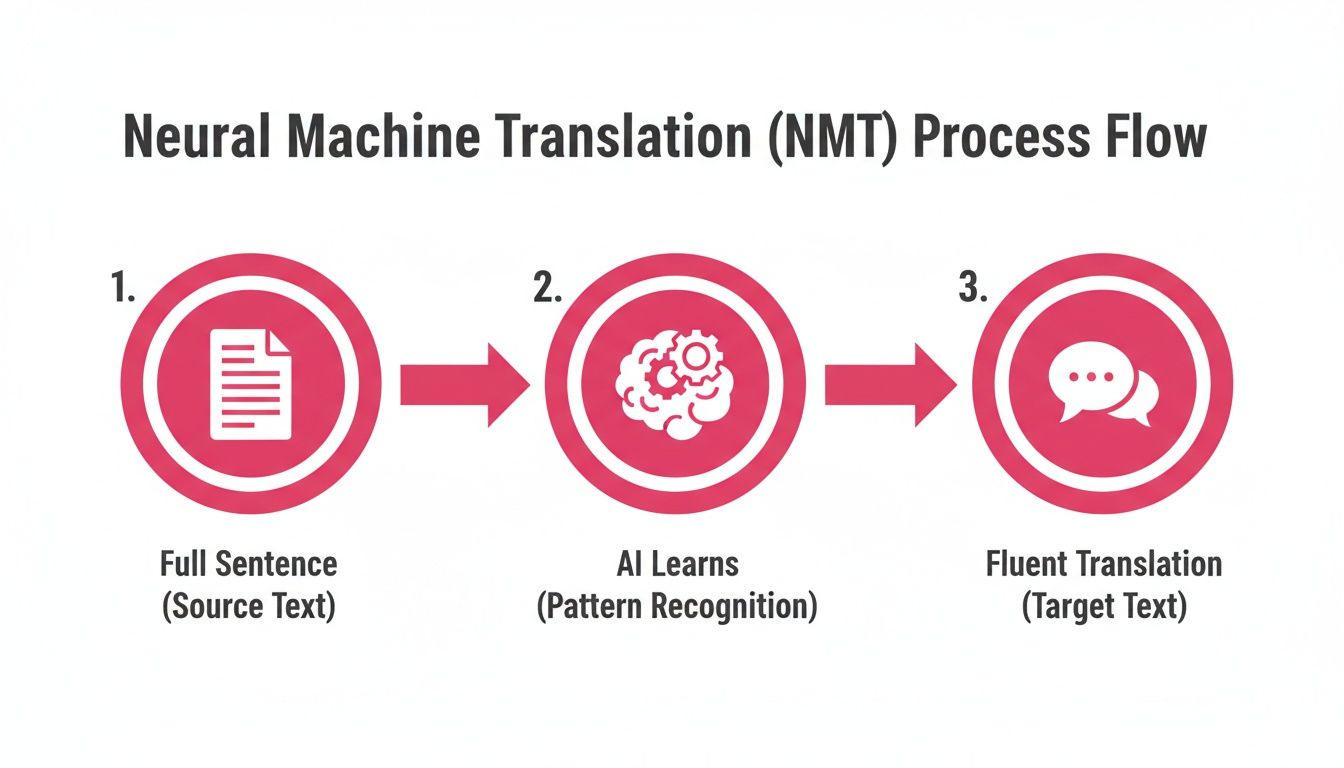
The key takeaway is that NMT operates holistically. It moves from a complete thought to a complete, natural-sounding translation, which is precisely where its power lies.
The Role of the Attention Mechanism
Early NMT models were a massive improvement, but they had an Achilles’ heel: long sentences. The encoder had to squash the meaning of dozens of words into a single, fixed-size vector, and sometimes, important details got lost in the compression. It was like asking our interpreter to memorize a five-minute speech before they could even start translating.
The solution was a game-changing addition called the attention mechanism. The best way to picture it is as giving the AI a highlighter. As the decoder builds the new sentence, the attention mechanism lets it “glance back” at the original text and focus on the specific words that are most relevant to the word it’s currently generating.
For instance, when it’s time to translate “rápidamente,” the attention mechanism puts a spotlight on that part of the source text. This ability to dynamically focus ensures no critical detail gets dropped, leading to far more accurate and dependable translations, especially with complex material. A deeper dive into concepts like prompt engineering can also offer insights into how we guide these models to produce better, more contextual outputs.
Why This Matters for Your Brand
This sophisticated process is what gives NMT-powered translations that human touch. For your website, it means your core message stays intact across different languages, protecting your brand’s voice and building trust with an international audience. Understanding context isn’t just a technical nicety; it’s a business imperative.
NMT’s ability to understand context ensures your message resonates culturally, not just linguistically. It prevents awkward or nonsensical translations that can damage your brand’s reputation and alienate potential customers.
By going far beyond simple word-for-word replacement, NMT creates a solid foundation for modern automated translation tools. It’s what allows a plugin to take a complex product description or a nuanced blog post on your WordPress site and produce a translation that’s right—or very close to it—from the get-go. This saves a massive amount of time on manual corrections, making global expansion a much more achievable goal for any business.
The Game-Changing Leap From SMT To NMT
Before Neural Machine Translation (NMT) came along, automated translation was a completely different beast. The reigning technology was Statistical Machine Translation (SMT), and to really appreciate why NMT was such a breakthrough, you have to understand what SMT was trying to do—and where it fell short.
Think of SMT as a meticulous but shortsighted librarian trying to assemble a sentence. It would scan massive libraries of existing human translations, learning which words and short phrases most often appeared together. When you gave it a new sentence, it would chop it up into these little chunks and then reassemble them in the new language based purely on statistical probability. It was a numbers game.
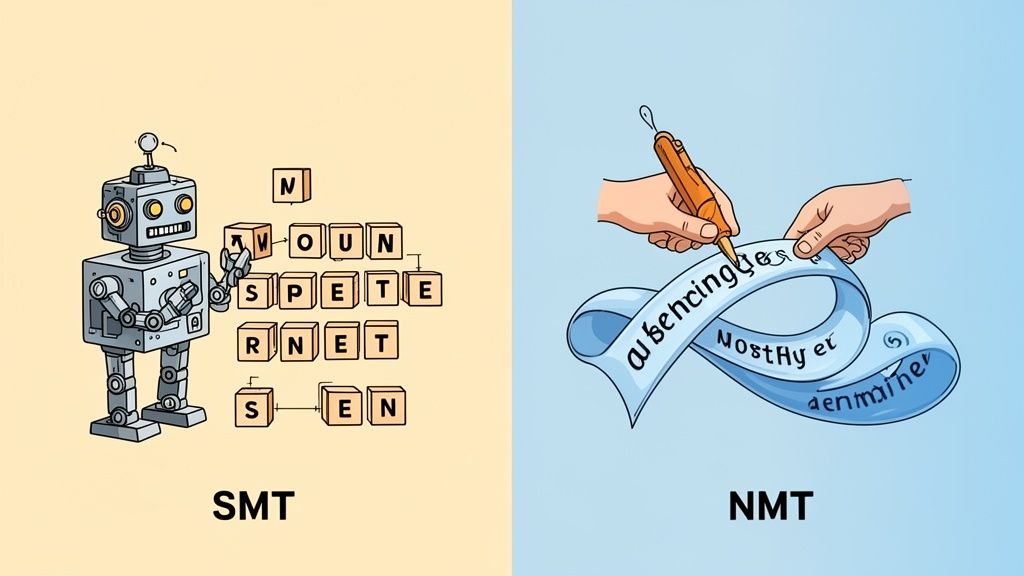
While clever, this piece-by-piece approach often produced translations that felt clunky and robotic. SMT’s fatal flaw was its complete lack of context. It could translate individual phrases reasonably well, but it had no idea how to string them together into a sentence that sounded like something a real person would say.
Why SMT Often Missed The Mark
The core problem was that SMT saw language as a collection of isolated fragments. It just couldn’t grasp the bigger picture, leading to some very common and frustrating issues.
- Grammatical Awkwardness: Since it was just matching phrases, SMT stumbled badly with complex sentences or languages with different word orders. The results were often grammatically messy.
- Lack of Fluency: The translations sounded exactly like what they were: a bunch of phrases glued together. They were missing the natural rhythm and flow of human language.
- Context Blindness: SMT had no reliable way to pick the right meaning for a word with multiple definitions. It was essentially guessing based on a few nearby words, and it often guessed wrong.
This is where NMT didn’t just improve things—it completely changed the game.
NMT’s arrival marked a fundamental shift from a model that matched phrases based on probability to one that actually comprehended entire sentences. It was the leap from a statistical “guessing game” to a contextual understanding of meaning, paving the way for the fluid, accurate translations we see today.
This technology started gaining serious traction after foundational research papers in 2014. Baidu was one of the first to deploy a live NMT system in 2015, but the real watershed moment came when Google rolled out its Neural Machine Translation (GNMT) in 2016. This new system, powering Google Translate, boosted quality by over 60% for many language pairs almost overnight. If you’re curious, you can learn more about the history of machine translation and this pivotal period.
How NMT Solved SMT’s Core Problems
NMT’s approach is holistic. By processing the entire sentence at once with its encoder-decoder architecture, it finally grasps the one thing SMT never could: context.
This deeper understanding means NMT can navigate complex grammar, choose the correct meaning for ambiguous words, and produce sentences that are not only accurate but also sound natural. The difference was night and day. Where SMT gave you a rough draft that needed a ton of editing, NMT started delivering translations that were often good enough to use immediately.
Here’s a quick breakdown of how these two technologies stack up.
NMT vs SMT Key Differences
The table below provides a clear, side-by-side comparison of the two approaches, highlighting the fundamental shift in capability.
| Feature | Statistical Machine Translation (SMT) | Neural Machine Translation (NMT) |
|---|---|---|
| Unit of Translation | Words and short phrases (chunks) | The entire sentence |
| Context Awareness | Very limited, only a few surrounding words | High, considers the full sentence context |
| Fluency and Quality | Often robotic and grammatically awkward | Natural-sounding and grammatically coherent |
| Handling of Idioms | Poor, usually results in literal, nonsensical output | Good, can often interpret and translate meaning correctly |
| Architecture | Based on statistical probability models | Based on artificial neural networks (encoder-decoder) |
This evolution is precisely why modern WordPress plugins can now reliably translate entire websites—from blog posts to thousands of product pages. NMT’s incredible leap in accuracy and fluency means far less time spent on manual corrections, making it a truly viable tool for taking your business global.
Measuring the Quality of NMT Output
So, you’ve got a translation from an NMT system. Now for the million-dollar question: is it any good? In the AI world, developers rely on automated metrics to get a quick read on a model’s performance. The most common one you’ll hear about is the BLEU score, which stands for Bilingual Evaluation Understudy.
Think of BLEU as a test of similarity. It takes the machine’s output and compares it against one or more high-quality human translations, checking for overlapping words and phrases. A higher score means the machine’s version is closer to the human reference, which suggests better accuracy.
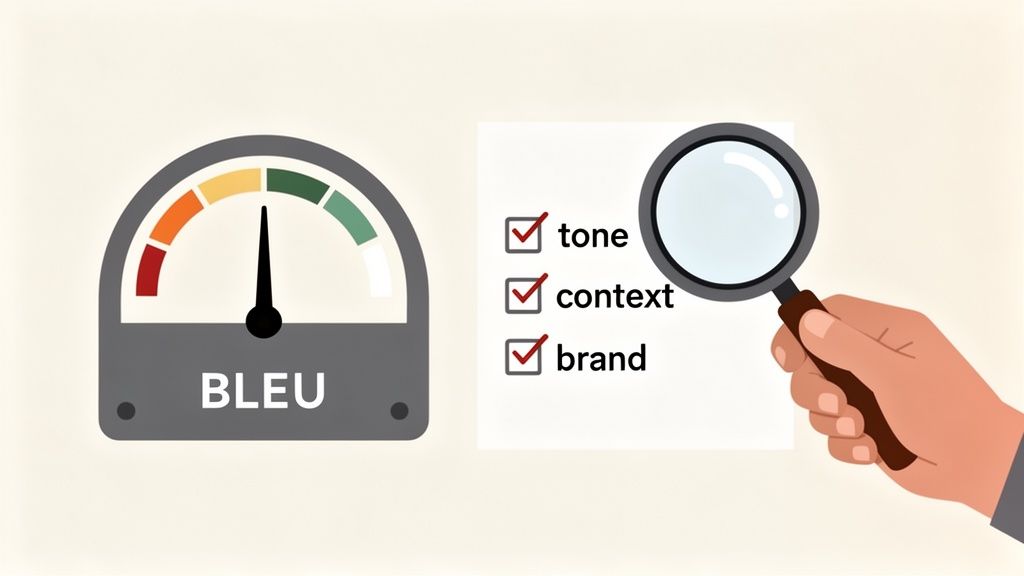
But here’s the catch: a high BLEU score doesn’t automatically mean you have a “good” translation for your website. While it’s a handy benchmark for engineers comparing raw model performance, it has some serious blind spots in the real world.
The Limits of Automated Scores
Metrics like BLEU are great at flagging obvious grammatical errors and checking if the right words were used. But they completely miss the subtle, human elements that make content actually work. A translation can be 100% grammatically correct and still fall flat on its face.
Here’s what these scores just can’t see:
- Brand Voice and Tone: Is your brand witty and informal, or serious and authoritative? An automated score has no idea.
- Cultural Nuance: A phrase that’s perfectly normal in one culture might be confusing or even offensive in another. BLEU can’t catch these crucial cross-cultural gaffes.
- Creative Language: Idioms, slogans, and clever marketing headlines need creative adaptation, not a literal, word-for-word swap.
- Subtle Inaccuracies: NMT can sometimes produce perfectly fluent sentences that are just plain wrong. These “hallucinations” are a huge risk, especially for technical or sensitive content.
A BLEU score tells you if the translation is technically similar, but it can’t tell you if it’s effective. For the content that truly matters—your landing pages, ad copy, or legal notices—nothing replaces a final review by a human eye.
Practical Steps for Quality Control
So, how do you make sure the translations on your WordPress site are actually hitting the mark? Instead of getting bogged down by technical scores, it’s better to take a practical, human-centered approach. This is also key when choosing a provider; you can dig deeper into the nuances by comparing OpenAI vs Google Translate and seeing which fits your project best.
Here are a few actionable steps you can take:
- Spot-Check Your MVP Pages: You don’t need to read every single translated word. Just identify your most valuable pages—the homepage, key product or service pages, and your top blog posts—and have a native speaker give them a once-over.
- Guide the AI with Custom Prompts: Modern translation plugins let you give the AI instructions. You can tell it to adopt a specific tone (“Translate this in a friendly, professional voice”) or provide a glossary of key brand terms to keep everything consistent.
- Listen to Your Audience: If you have an international user base, add a simple feedback button or form to your translated pages. Asking readers if the content is clear and helpful gives you direct, real-world insight into how well your translations are working.
Ultimately, the smartest approach is a hybrid one. Use NMT for its amazing speed and scale to get 90% of the way there, then layer on targeted human review and fine-tuning to make sure your message connects perfectly with every audience.
Putting NMT to Work on Your WordPress Site
Okay, so we’ve covered the theory behind Neural Machine Translation. But how do you actually make it a workhorse for your WordPress site—something that saves you real time and money?
The good news is, you no longer need a team of developers to get this done. Modern plugins have made this powerful technology incredibly easy to use, turning what was once a complex integration into a simple setup process.
These tools act as a bridge, connecting your website directly to the world’s most advanced NMT models through their APIs. That means you can translate posts, pages, and even tricky custom content with just a few clicks, all without ever having to leave your WordPress dashboard.
Choosing the Right Translation Provider
When you pick a translation plugin, you’re not just choosing the software itself—you’re also choosing the AI engine that will do all the heavy lifting. Each provider has its own unique personality and strengths, so the best choice really boils down to what you need, balancing translation quality against cost.
Here are the main players you’ll come across:
- OpenAI (GPT Models): Famous for producing exceptionally fluent and natural-sounding translations. If your priority is nailing brand voice and a creative tone for things like marketing copy or blog posts, GPT is often the top contender.
- Google (Gemini Models): A rock-solid, reliable choice that supports a staggering number of languages. Google’s models are a fantastic all-around option for broad, general-purpose content.
- Anthropic (Claude Models): These models shine when it comes to handling long-form content. They’re great at keeping track of context over thousands of words, making them a perfect fit for translating detailed articles, technical documentation, or legal pages.
- OpenRouter: Think of this as a universal remote for AI models. It’s a gateway service that gives you access to a huge variety of models from different providers, letting you experiment to find the absolute best cost-to-performance ratio for your specific content.
The real key is to use a plugin that lets you switch between these providers without a fuss. That flexibility is what allows you to test different engines and find that perfect sweet spot for your budget and quality standards.
Mastering Bulk Translation and Automation
The single biggest win of using NMT on your site is the sheer scale it offers. Imagine translating hundreds of blog posts or thousands of WooCommerce products in minutes, not months. This is where bulk translation features become absolutely essential.
For businesses, the impact of this automation is massive. Companies have reported 50-70% savings on their localization efforts for multilingual WordPress sites. NMT’s ability to handle long sentences 30% more accurately than older statistical methods is crucial for e-commerce, helping to boost conversions by 20-30% in non-English speaking markets.
The process is usually dead simple, as you can see in this screenshot from a popular translation plugin.
This clean interface lets you tick a few boxes, select your target languages, and translate everything at once. It completely transforms a tedious, manual chore into a fast, automated workflow. If you want a more detailed walkthrough, our guide on how to translate a WordPress page breaks it down step-by-step.
Preserving Brand Voice with Customization
Speed is great, but quality is what keeps visitors coming back. Your brand has a unique voice, and it’s critical that this voice stays consistent no matter the language. Thankfully, modern NMT tools give you powerful ways to maintain that control.
The goal isn’t just to translate words; it’s to translate your brand. Using custom prompts and glossaries ensures the AI works as a partner that understands and respects your specific communication style.
Here are two key features you should look for:
- Custom Prompts: This lets you give the AI specific instructions before it starts translating. You can guide its tone (“Translate this in a formal, professional voice”), give it context (“This is for a product description targeting expert users”), or even ask it to adapt the content for a specific culture.
- Glossaries: Got brand names, product features, or industry terms that should never be translated? A glossary is your best friend. It lets you create a list of “do-not-translate” terms, ensuring the AI keeps them perfectly consistent across your entire site.
By combining the raw power of NMT with these smart customization features, you can build a multilingual website that is not only translated quickly but also accurately reflects your brand’s identity in every single market.
The Future of NMT and Global Communication
Neural Machine Translation is fundamentally changing the way businesses talk to the world. It’s not just a minor tech upgrade; it’s a strategic shift that makes scalable, authentic global communication a reality. By looking at the whole sentence, NMT finally gets the context and subtle meaning that older technologies always fumbled.
This ability to grasp the bigger picture is huge. It means businesses can build real relationships with customers anywhere. Instead of clunky, robotic text, NMT delivers smooth, natural-sounding content that keeps your brand’s voice consistent, no matter the language. This isn’t just about swapping words—it’s about creating a genuine connection.
Unlocking Global Opportunities
The future for AI translation is incredibly exciting, with new breakthroughs constantly knocking down language barriers. The tech is getting smarter, learning to pick up on tricky things like sarcasm, humor, and cultural nuances with much better accuracy. This constant improvement is making global expansion easier and cheaper than ever before.
NMT is the engine that drives modern localization. It allows companies to launch in new markets faster, connect with diverse audiences in a meaningful way, and operate on a global scale without the crippling costs of old-school translation.
For any business with ambitions to grow, the path forward is clear. Using NMT-powered tools is the most direct way to simplify your workflow, slash operational costs, and open up new revenue streams in international markets. It turns a massive headache into an automated, manageable process.
When you truly understand what localization means for your business, you can see just how NMT makes these big goals reachable. At this point, embracing the technology isn’t just an option—it’s essential for staying competitive.
NMT: Your Questions Answered
If you’re thinking about using neural machine translation for your website, you probably have a few practical questions. Let’s get right into the common ones that pop up.
Is Neural Machine Translation Actually Better Than Human Translation?
This is the big question, but it’s not really a fair fight. It’s more about picking the right tool for the right situation.
NMT is a powerhouse for speed and scale. It can translate massive volumes of content almost instantly at a fraction of the cost of a human translator. For most of your site’s content—blog posts, product descriptions, general pages—the quality is more than good enough.
But when it comes to the content that truly defines your brand, a human touch is still unbeatable. Think creative ad copy, your company slogan, or critical legal text. A person understands nuance, cultural context, and stylistic flair in a way that AI is still learning to mimic.
The smartest approach is a mix of both. Let NMT do the heavy lifting for 90% of your site, then bring in a human editor to polish your most important pages.
Which AI Model Is Best For Translating a WordPress Site?
There’s no single champion here. The “best” model really comes down to your specific needs—what languages you’re targeting, the type of content you have, and your budget.
- OpenAI’s GPT models are fantastic for their fluency and knack for creative language.
- Google’s Gemini is a workhorse, delivering solid, reliable translations across a huge range of languages.
- Anthropic’s Claude shines when you need to translate long-form content while keeping the context straight.
Your best bet? Use a plugin that lets you connect to several different providers. That way, you’re not locked in. You can experiment to find the perfect balance of quality and cost for your specific project.
Choosing an AI model is like picking a specialist. You wouldn’t ask a heart surgeon to fix your knee. Matching the model’s strengths to your content—whether it’s technical, creative, or just everyday text—is the key to getting great results.
What’s the Real Cost of Using NMT on a Website?
Here’s the good news: using NMT is dramatically cheaper than traditional translation. Forget about high per-word rates from agencies. With NMT, you pay for API access directly to providers like OpenAI or Google, and the cost is usually just a tiny fraction of a cent per word.
For a WordPress user, the investment breaks down into your plugin subscription and the API fees from your chosen AI provider. Businesses often see cost savings of 70-80% or more compared to doing everything by hand. This means you can translate your entire website for what it might have cost to manually translate just a few key pages. Suddenly, reaching a global audience feels a lot more achievable.
Ready to unlock global markets without the massive overhead? EPIC WP Solutions builds AI-powered plugins that make scaling your WordPress site effortless. Our Polylang Automatic AI Translation plugin lets you translate your entire site in minutes, not months, while preserving your brand’s unique voice. Learn more and start your global journey today at EPIC WP Solutions.