The core difference between DeepL and Google Translate really comes down to a trade-off: nuanced accuracy versus massive language coverage.
DeepL has earned its reputation for producing translations that sound remarkably human. They’re more natural, context-aware, and do a better job of preserving a brand’s specific voice. It's often the go-to for high-stakes content where quality is non-negotiable.
Google Translate, on the other hand, prioritizes global reach. It offers an unmatched number of languages, making it the clear winner when you need to make your content accessible to as many people as possible, even if the translation isn't perfectly fluent.
DeepL vs Google Translate The Quick Verdict
So, which AI translation engine should you choose for your WordPress site? The truth is, there's no single "best" option. It all comes down to your specific goals. The right choice hinges on balancing the quality of the translation with the sheer breadth of your target audience.
If your business relies heavily on brand identity, marketing precision, and a polished user experience, DeepL is almost always the better choice. Its neural network is fantastic at grasping context and subtlety, so the output feels less like a machine and more like a human wrote it. This is a game-changer for persuasive copy aimed at converting customers in competitive markets.
But if your main goal is simply to make your content available to the widest possible global audience, Google Translate's massive language library is indispensable. Supporting hundreds of languages and dialects that DeepL doesn't cover, it's the go-to engine for news sites, forums, or informational blogs aiming for maximum inclusivity.
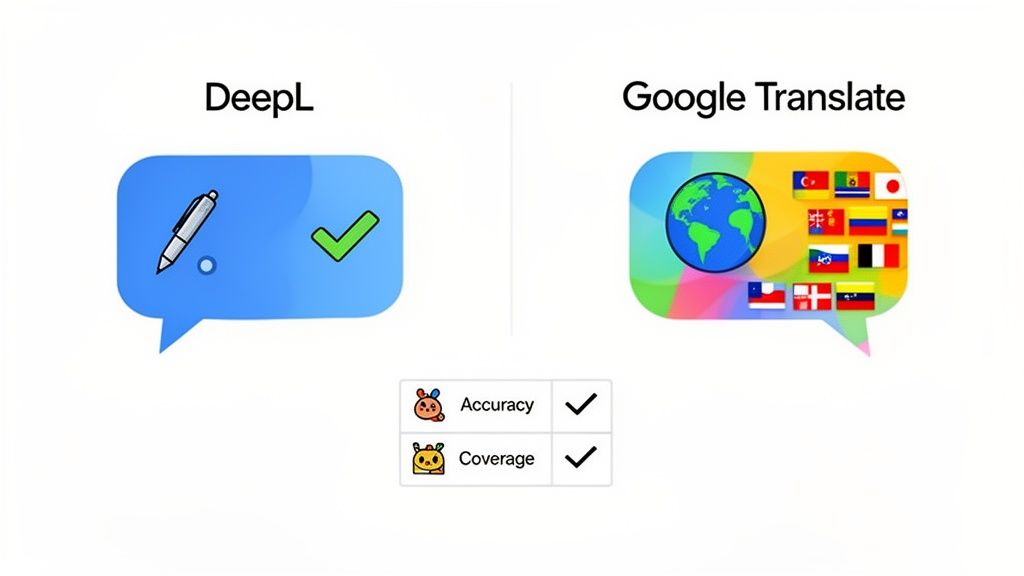
At a Glance DeepL vs Google Translate
Let's break down the key differences to help you decide which tool aligns with your website’s needs.
| Criterion | DeepL | Google Translate |
|---|---|---|
| Primary Strength | Superior contextual accuracy and natural-sounding translations, preserving nuance and brand voice. | Unmatched language coverage, supporting hundreds of languages and dialects for maximum global reach. |
| Ideal Use Case | Translating marketing copy, business documents, and high-visibility website content for key target markets. | Making content accessible in a vast number of languages, especially for less common or regional dialects. |
| Language Support | Focused support for around 30+ languages, primarily excelling with European language pairs. | Extensive support for over 130+ official languages, plus numerous regional variations and dialects. |
| Customization | Offers user-friendly features like formality controls (formal/informal) and glossaries to maintain consistency. | Provides advanced customization through its Cloud Translation API, allowing for custom models and glossaries. |
| WordPress Integration | Easily integrated into WordPress using plugins like the Polylang Automatic AI Translation plugin to automate content workflows. | Also seamlessly integrates with WordPress via plugins, enabling bulk translation for posts, pages, and products. |
This table gives you a great starting point, but the decision doesn't have to be black and white.
The most effective strategy often involves a hybrid approach. You don't have to choose just one. By using a flexible plugin, you can leverage DeepL for your most important languages and Google Translate for others, optimizing both quality and cost.
The New Era of AI Translation for Websites
Before we dive into a head-to-head comparison of DeepL vs Google Translate, it helps to understand the world they now dominate. Translation isn't what it used to be—a choice between expensive human translators and clunky, word-for-word machine outputs. We're in a new age, one powered by sophisticated artificial intelligence that has completely changed how businesses, especially on WordPress, can reach a global audience.
This isn't just a small shift. It's a massive market overhaul. The global translation industry is projected to hit $62.12 billion by 2025. A huge chunk of that growth is coming from AI. In fact, the AI text translation market alone is expected to jump from $2.18 billion in 2023 to a staggering $13.37 billion by 2030. These numbers tell a clear story: businesses are all-in on AI to scale their multilingual efforts.
Why This Matters for WordPress Site Owners
For anyone running a WordPress or WooCommerce site, this is a massive opportunity. What used to be an expensive, time-sucking project is now within reach for businesses of all sizes. Modern AI makes professional-grade translation an on-demand service, tearing down the old barriers to global expansion.
This means picking a translation engine is now a serious business decision, not just a technical one. And this AI-driven change isn't just happening in translation. The rise of AI website builder tools shows how deeply this technology is reshaping the way we build and manage our online presence.
Think about it: a small e-commerce shop in Ohio can now genuinely compete for customers in Germany, France, and Japan. They can do it with localized content that actually connects with native speakers. A decade ago, that would have been a pipe dream.
The engine driving all this is neural machine translation (NMT). Older systems worked by swapping words one by one, which often led to awkward, nonsensical results. NMT, on the other hand, looks at whole sentences to grasp context, grammar, and even subtle nuances. This is the magic behind the remarkably human-like translations from services like DeepL and Google Translate. If you want to get into the technical weeds, you can learn more about it in our guide on what is neural machine translation.
A New Standard for Multilingual Websites
This leap forward has set a new standard. Today's online visitors have little patience for clumsy, machine-translated text—it instantly damages your credibility and makes for a terrible user experience. Modern AI tools give website owners the power to deliver professional, enterprise-level quality, creating a smooth and trustworthy experience for international customers.
And that brings us to the core of this comparison. Choosing between DeepL and Google Translate isn't like picking a font. It's about selecting a partner for your global strategy. The quality, language support, and features of your chosen engine will directly shape how well you connect with customers around the world.
Comparing Translation Quality and Accuracy
When you're deciding between DeepL and Google Translate, the rubber really meets the road on translation quality. This is the single most important factor. While both platforms are built on sophisticated neural machine translation, they often produce surprisingly different results, especially when you throw complex or nuanced content at them. This isn't just about getting words right; it's about preserving the original meaning, tone, and your brand's voice.
At a high level, Google Translate is a master of breadth. It processes billions of words every single day across a staggering number of languages. For common language pairs like English to Spanish, its accuracy can be impressive—often hitting over 90%—simply because it has so much data to learn from. But its performance can get a bit shaky with less common languages or more creative, marketing-focused text.
DeepL, on the other hand, built its entire reputation on depth. It excels at grasping the underlying context of a sentence, which leads to translations that feel more fluid and sound more natural. For any business, this is a massive advantage. It means your brand integrity stays intact, and your marketing messages land just the way you intended.
Putting Them to the Test: Real-World Examples
To see how these differences play out in practice, let's compare their performance on three common types of text a website owner deals with every day. We'll translate a common idiom, a technical sentence, and a marketing tagline from English to German.
1. The Idiom: "Bite the bullet"
- Original (English): We have to bite the bullet and invest in the new software.
- DeepL (German): Wir müssen in den sauren Apfel beißen und in die neue Software investieren. (Correct idiomatic translation: "We have to bite the sour apple…")
- Google Translate (German): Wir müssen auf die Zähne beißen und in die neue Software investieren. (Literal translation: "We have to bite our teeth…")
Right away, you can see the difference. DeepL correctly identifies the English idiom and swaps it for its proper German equivalent, "in den sauren Apfel beißen." Google Translate gives a more literal, slightly awkward translation that, while understandable, sounds clunky and unnatural to a native speaker.
2. The Technical Sentence
- Original (English): The server's API endpoint requires OAuth 2.0 authentication for secure data retrieval.
- DeepL (German): Der API-Endpunkt des Servers erfordert eine OAuth 2.0-Authentifizierung für den sicheren Datenabruf.
- Google Translate (German): Der API-Endpunkt des Servers erfordert eine OAuth 2.0-Authentifizierung für einen sicheren Datenabruf.
In this case, both engines nail it. They correctly translate the technical jargon without any mistakes, showing that for straightforward, technical content, the quality gap is much smaller. The only tiny difference is DeepL's use of "den sicheren" versus Google's "einen sicheren," both of which are grammatically correct.
3. The Marketing Tagline
- Original (English): Unlock Your Potential.
- DeepL (German): Entfalten Sie Ihr Potenzial. (More sophisticated: "Unfold your potential.")
- Google Translate (German): Schalte dein Potenzial frei. (More literal: "Unlock your potential," using the informal "du.")
With marketing copy, nuance is everything. DeepL’s "Entfalten Sie" is a more elegant and professional-sounding phrase, perfect for a business context. Google's translation is direct but uses the informal "du," which might be too casual and not at all appropriate for certain brand voices.
Data-Backed Insights on Accuracy
This pattern of DeepL excelling in nuance isn't just anecdotal; it's backed by industry data. A survey by the Association of Language Companies (ALC) found that a staggering 82% of professional language service companies now use DeepL for their work, compared to just 46% using Google Translate.
What’s more, in blind tests conducted by language experts, DeepL's translations were found to be 1.3 times more accurate than Google Translate's output. For anyone managing a multilingual WordPress or WooCommerce site, this accuracy difference translates directly into a better user experience for your international customers. You can explore more of these findings about AI translation accuracy.
The image above highlights the kind of subtle (and sometimes not-so-subtle) differences you can encounter. A clean, context-aware translation is critical, and it's where DeepL often shines.
For WordPress site owners, the key takeaway is this: If your content is high-stakes—like product descriptions, landing pages, or legal policies—DeepL's superior contextual understanding often justifies its use. A slightly more accurate translation can make the difference between a sale and a lost customer.
Ultimately, while both tools are incredibly powerful, the decision comes down to your content's specific demands. For broad reach and simple text, Google Translate is a workhorse. For quality, nuance, and protecting your brand's voice in key markets, DeepL consistently holds the edge.
A Deep Dive into Features and Customization
Raw translation quality is just the start. For a real-world WordPress site, the practical features and customization options are what really make or break a translation engine. This is where we move past pure accuracy and look at the tools that help you protect your brand, manage your workflow, and get your content translated without headaches.
The first, most obvious difference is language coverage. Google Translate is the undisputed giant here, with support for over 130 languages plus countless regional dialects. If your goal is maximum global reach, especially into smaller markets in Asia or Africa, Google is often the only game in town.
DeepL, on the other hand, plays a different game. It focuses on a curated list of around 30+ languages, prioritizing incredible quality for major global markets, especially in Europe. Think of it as a quality-over-quantity approach. While its roster is smaller, the translations for the languages it does support are often more natural and reliable.
Control and Consistency with Glossaries
One of the most critical tools for any business is the glossary. It lets you lock in specific translations for brand names, product titles, or technical jargon that must never be translated incorrectly. It's your first line of defense against embarrassing mistakes.
Both services offer glossaries, but their implementations couldn't be more different:
- DeepL's Glossary: This is a standout feature, and it’s brilliantly simple. You can create and manage your term list right in the interface, no coding required. DeepL even has a smart feature that suggests terms from your past translations, which is a fantastic time-saver.
- Google's Glossary: Google's version is just as powerful, but it’s tucked away inside its Cloud Translation API. This makes it a great tool for developers and enterprise teams, but it’s not very friendly for the average user who just wants to make a few quick rules.
If you're a site owner who needs to make sure your brand name "EverGlow" doesn't get butchered, DeepL’s straightforward glossary wins hands down.
By defining key terms in a glossary, you take control away from the AI and enforce your brand's specific language. This simple step prevents common and often embarrassing translation errors on your most important pages.
Setting the Right Tone with Formality Controls
Another huge differentiator, particularly for European languages, is formality. Languages like German (Sie vs. du) or French (vous vs. tu) have formal and informal versions of "you." Using the wrong one can make your brand sound unprofessional or, just as bad, awkwardly stiff.
DeepL has a simple, built-in formality toggle for many of its languages. With a single click, you can switch the entire translation's tone. It's an incredibly useful tool for making sure your marketing copy connects perfectly with your target audience.
Google Translate doesn't have a simple, built-in switch for this. Getting the tone right often means more manual editing or complex API setups. While newer Large Language Models (LLMs) are introducing much more advanced tone adjustments, as we've covered in articles about why LLMs can be a better choice than DeepL, DeepL’s direct formality control is a major practical advantage.
Handling Website Code and APIs
When translating a website, you need an engine that understands not to translate your code. Things like <strong>, <a>, and <span> tags need to be left alone. Thankfully, both DeepL and Google Translate are very good at identifying and preserving HTML markup, ensuring your site’s layout doesn’t break.
On the developer front, both platforms provide robust APIs for seamless integration.
| Feature Comparison | DeepL | Google Translate |
|---|---|---|
| Language Coverage | Focused (30+ languages) | Extensive (130+ languages) |
| Glossary Feature | User-friendly, built-in | Powerful, but API-focused |
| Formality Control | Simple, built-in toggle | Requires manual editing or API |
| API Pricing Model | Subscription-based tiers | Pay-as-you-go |
Their pricing models are where they really diverge. DeepL uses subscription tiers for its API access, giving you predictable monthly costs if your translation needs are steady. Google Translate works on a flexible pay-as-you-go model, which can be cheaper for sites with occasional or fluctuating translation volumes. This is a key business decision that depends entirely on your budget and how often you'll be translating content.
Making the Right Choice for Your WordPress Site
Deciding between DeepL vs Google Translate isn't about picking a single winner. It’s about matching the right tool to the right job. The best engine for your WordPress site hinges on your specific goals, the audience you’re trying to reach, and the kind of content you're translating. There's no one-size-fits-all answer here, just a strategic choice based on your project's unique demands.
Think about it this way: a luxury e-commerce store built on WooCommerce needs to sound perfect for its affluent customers in France and Germany. In this scenario, you'd lean on DeepL. Its knack for nuanced, context-aware translations is crucial for keeping that premium brand voice consistent and making sure your marketing messages hit the mark.
Now, imagine you run a global news blog trying to reach dozens of smaller markets. Here, Google Translate becomes your most valuable player. Its massive language coverage lets you connect with audiences that DeepL simply can’t, maximizing your global footprint even if the translations aren't quite as poetic.
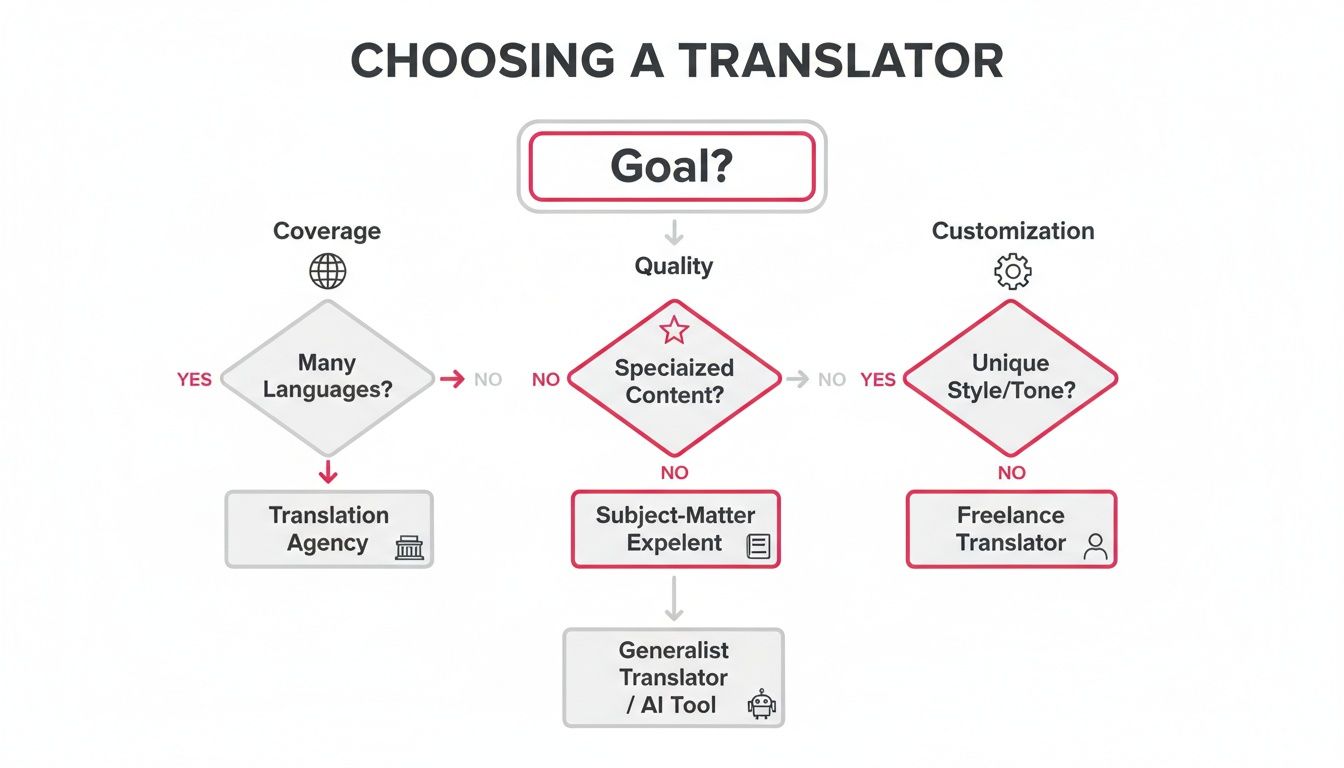
This flowchart can help you visualize that decision-making process, guiding you based on whether quality, coverage, or customization is your top priority.
The key takeaway is that your translation strategy should directly serve your business objectives for each market you enter.
Choosing Based on Content Type
The what is just as important as the who. Different types of content call for different translation strengths.
- Creative and Marketing Copy: For landing pages, product descriptions, or blog posts where tone and brand voice are everything, DeepL is usually the way to go. It just has a better feel for the subtle nuances that persuade and engage readers.
- Technical Documentation: When you’re translating support articles, FAQs, or technical guides, the accuracy gap gets a lot smaller. Both engines do a solid job, but DeepL's ability to handle really complex sentence structures can give it a slight advantage.
- User-Generated Content: If you're dealing with comments, reviews, or forum posts where you just need basic comprehension, Google Translate is perfect. It’s fast, broad, and gets the general meaning across effectively.
The Impact of Your Website Platform
The platform your site is built on also influences your approach to localization. When you’re figuring out the best foundation for your website, it’s worth comparing your options, like when choosing between WordPress and other builders. WordPress, in particular, offers incredible flexibility for multilingual projects, especially when it comes to integrating various translation services.
The core takeaway is that the 'best' engine is entirely situational. A high-stakes product launch in a major European market demands DeepL's precision, while a broad informational campaign across Southeast Asia is better served by Google Translate's reach.
This realization leads to a powerful conclusion: why stick to just one? The smartest strategy is to build a flexible system that lets you pick the best tool for each specific task. You can get more details on this by exploring different approaches to translation and localization for your site.
Ultimately, trying to make one engine handle all your diverse needs is inefficient and will likely compromise quality somewhere. The ideal setup is one that lets you harness the strengths of both DeepL and Google Translate—and even other AI models—all within a single, unified workflow. That’s when a flexible integration stops being a convenience and becomes a real strategic advantage for any serious multilingual WordPress site.
The Hybrid Solution for Ultimate Flexibility
The whole "DeepL vs. Google Translate" debate often frames it as an either/or choice. But what if you didn't have to pick just one? For a WordPress site, the smartest and most cost-effective strategy isn't about committing to a single engine. It’s about building a flexible system that lets you use the right tool for the right job, every single time.
This is where a hybrid approach really shines. Imagine using DeepL for its nuanced, high-quality translations on your critical German product pages, while tapping into Google Translate's massive language library to make your blog posts accessible in Thai and Hindi. This strategy lets you balance premium accuracy where it counts with broad reach where it matters.
Unlocking a Multi-Engine Strategy
This kind of powerful workflow is entirely possible with tools designed to bring multiple AI engines right into your WordPress dashboard. Instead of being locked into one provider, you get the freedom to mix and match translation services based on what a specific language or piece of content actually needs.
A perfect example of this is the Polylang Automatic AI Translation plugin. It acts as a central hub, connecting your site not only to DeepL and Google Translate but also to advanced Large Language Models like OpenAI (ChatGPT) and Gemini. You basically have a full arsenal of translation tech at your fingertips.
By adopting a hybrid model, you shift from a restrictive 'either/or' decision to a strategic 'when and where' approach. This gives you incredible control over both translation quality and your budget.
You can even set up rules to automate the whole process. For instance, you could configure the plugin to use a premium engine for your primary European markets and a more cost-effective one for less critical languages, all managed from one simple interface.
The Benefits of a Flexible Workflow
This multi-engine approach has some major advantages for anyone running a WordPress or WooCommerce site:
- Cost Optimization: You only pay for premium quality where it directly impacts your revenue. For everything else, you can use a more budget-friendly option.
- Maximized Quality: You can assign the best-performing engine for each specific language pair, ensuring you get the most accurate result possible every time.
- Future-Proofing: As new and better AI models come out, a flexible plugin lets you integrate them without having to rebuild your entire translation workflow.
In the end, the best answer to the DeepL vs. Google Translate dilemma is to use a tool that lets you have both. The Polylang Automatic AI Translation plugin delivers this exact flexibility, turning a complex decision into a simple, powerful, and adaptable strategy.
Common Questions Answered
When you're trying to pick a side in the DeepL vs. Google Translate matchup, a few key questions always pop up, especially for anyone running a WordPress site. Let's get straight to the practical answers you need.
So, Is DeepL Always Better Than Google Translate for Websites?
Not always, no. While DeepL often delivers translations that feel more natural and human, especially for marketing copy in major European languages, its superiority isn't universal. It's fantastic at maintaining your brand's specific tone of voice, which is a big deal for your most important pages.
But Google Translate's ace in the hole is its sheer scale. If your main goal is casting the widest net possible and reaching markets that DeepL doesn't even cover, Google's massive language library gives it the edge. For your core business content where quality is non-negotiable, DeepL is usually the winner. For everything else, it's a trade-off.
Which One Is Better for Multilingual SEO?
The simple answer is this: the engine that gives you the best translation is the best one for SEO. Search engines are all about user experience. Awkward, machine-sounding text makes people leave, sending negative signals that can drag down your rankings.
Since DeepL often produces more fluid and context-aware translations, it generally gives you a stronger SEO foundation right out of the box.
Think of it this way: a better translation encourages visitors to stick around, telling Google your content is worth their time. Of course, this is only half the battle—technical SEO elements like
hreflangtags and localized URLs, which a plugin like Polylang handles, are just as important.
How Do I Actually Use AI to Translate My Polylang Site?
The most straightforward way is with an integration plugin that connects WordPress directly to the AI translation engines. This approach brings the entire workflow inside your dashboard, so you can ditch the tedious copy-pasting for good.
Using a dedicated tool means you can translate everything—posts, pages, WooCommerce products, and even custom fields—all at once. It's a huge time-saver and keeps your whole multilingual operation running smoothly from one place.
Can I Mix and Match Translation Engines on the Same Site?
Absolutely, and honestly, it’s often the smartest and most budget-friendly way to do it. A plugin that supports multiple AI engines lets you build a powerful hybrid translation strategy for your WordPress site.
For instance, you could use a top-tier engine like DeepL for your primary languages where quality is critical (say, German and French) while using a more cost-effective option for less critical languages. This kind of flexibility lets you strike the perfect balance between quality and cost, without juggling different tools.
For WordPress users ready to build this kind of flexible, multi-engine strategy, EPIC WP Solutions has the perfect solution. The Polylang Automatic AI Translation plugin works seamlessly with DeepL, Google Translate, OpenAI, and Gemini, putting you in complete control of your multilingual workflow.