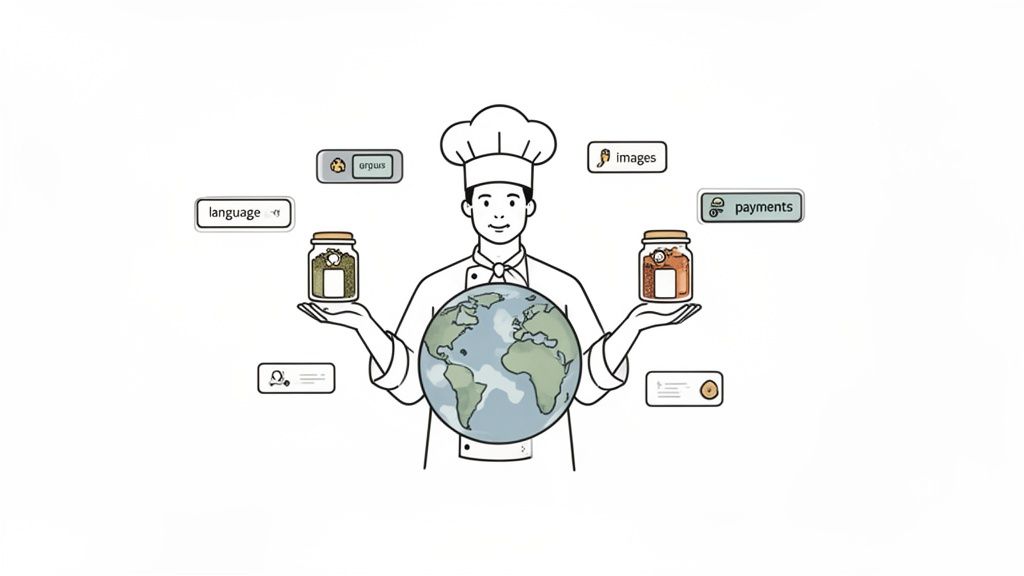
Let’s be clear: localization is so much more than just translating your website. It’s the art of adapting your entire digital presence—your content, products, and services—to feel like it was born and raised in a specific local market. Think of it less like translating a menu and more like tweaking the entire recipe to match local tastes.
Beyond Translation: The Core of Cultural Adaptation
It’s a common misstep to assume that swapping out English text for Spanish or Japanese is enough to win over a new audience. While translation is a vital piece of the puzzle, it only solves the language problem. Localization, often shortened to l10n in the industry, digs much deeper. It’s a strategic overhaul of your digital experience to meet the cultural, functional, and linguistic norms of a target region.
This is how you build real trust. When a potential customer from another country lands on your site, they shouldn’t feel like an outsider looking in. They should feel like you created it just for them. To really grasp the concept, it helps to understand what is language localization and why it’s a world apart from simple word-for-word translation.
What Does True Localization Involve?
Great localization examines every single detail of the user experience. It’s not just about the words you choose, but the entire context you build around them. This means fine-tuning all the little things that a direct translation would completely overlook.
Some of the key areas you’ll need to adjust include:
- Cultural Nuances: Swapping out idioms, humor, and pop culture references for ones that will actually land with the local audience. At the same time, you’ll need to avoid phrases that might be confusing or even offensive.
- Visual Elements: Changing images, graphics, and even color palettes to align with local sensibilities. A thumbs-up gesture might mean “great!” in the U.S., but it’s deeply offensive in parts of the Middle East.
- Functional Adjustments: Formatting dates, times, currencies, and units of measurement to match local standards is non-negotiable. It removes friction and makes your site feel intuitive.
- Legal Compliance: Updating your privacy policies, terms of service, and any other legal copy to meet regional laws, like GDPR in Europe, is absolutely critical.
The ultimate goal of localization is to create an experience so seamless and culturally in-tune that users don’t even realize the content came from another country. It’s about erasing that feeling of “foreignness” to build an instant, natural connection.
Localization vs Translation at a Glance
This table breaks down the crucial differences between basic translation and strategic localization, revealing why the latter is essential for genuine market success.
| Aspect | Translation | Localization |
|---|---|---|
| Scope | Converts text from one language to another. | Adapts the entire product or content for a specific region. |
| Focus | Linguistic accuracy and grammar. | Cultural relevance, user experience, and context. |
| Elements | Words and sentences. | Text, images, colors, currencies, date formats, legal info. |
| Goal | To make content understandable. | To make content feel natural, trustworthy, and native. |
| Analogy | Translating a recipe's instructions. | Adapting the recipe's ingredients and flavor for local tastes. |
As you can see, translation is a task, while localization is a complete strategy. One informs, the other connects.
The Chef Analogy Revisited
Let’s go back to that world-class chef opening a restaurant in Tokyo. Simply translating their French menu into Japanese is a start, but it won’t fill the seats.
Real success—real localization—happens when the chef starts using local ingredients, adjusts the spice levels to the Japanese palate, and presents the food in a way that respects local dining customs.
That’s exactly what localization does for your brand online. It ensures your message isn’t just understood, but genuinely embraced.
Adapting Your Content Beyond the Words
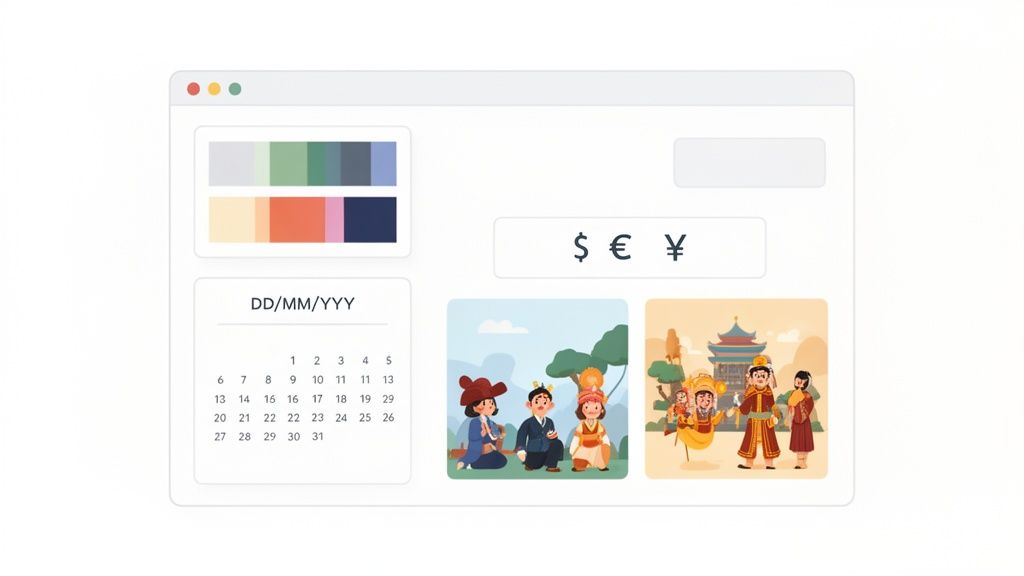
If you think swapping out English for Spanish is the finish line for localization, you’ve only made it halfway through the race. Real adaptation lives in the details that a direct word-for-word translation completely misses. It’s in these non-textual elements where brands either build unshakable trust or create an experience that just feels… off.
Think about it. You’re in the US, ready to buy something online, and the price is listed as “€1,299.00“. That tiny detail can plant a seed of doubt. Will my card work? Are there hidden conversion fees? This small moment of friction is exactly what proper localization prevents.
To truly understand localization, you have to look at your entire user experience through a new cultural lens. It’s about making sure every single component, from the colors on the page to the currency symbols, feels like it was made for them.
Cultural Cues in Design and Imagery
Visuals hit us faster than words, and their meaning can shift dramatically across borders. A brilliant marketing campaign in one country can completely flop in another if the imagery feels culturally out of place.
Color psychology is a classic example. In the West, white often symbolizes purity and weddings. But in many East Asian cultures, it’s the traditional color of mourning. Imagine launching a celebratory landing page for a Japanese audience using a stark white design—you’d be sending a confusing, even somber, message.
Imagery is just as critical. The people in your photos and videos need to look like your target audience. Using stock photos of a North American family to sell a product in South Korea creates an instant disconnect.
True localization makes your brand feel like a friendly neighbor, not a foreign corporation. It’s about showing your audience, “We see you, we understand you, and we built this for you.”
Functional Adjustments for a Seamless Experience
Beyond cultural vibes, localization gets into the nitty-gritty functional parts of your website that people use every day. Getting these wrong creates instant usability problems and can torpedo your credibility. For any business serious about global growth, these adjustments aren’t optional.
Here are the key functional adaptations you can’t ignore:
- Currency: Displaying prices in the local currency (¥ for Japan, R$ for Brazil, etc.) is a must. It removes the mental math for the user and signals that you’re truly open for business in their market.
- Date and Time Formats: In the United States, October 5th, 2025, is written as 10/05/2025. In most of Europe, that same date is 05/10/2025. This simple difference can cause massive confusion for event registrations, shipping estimates, and appointments.
- Units of Measurement: An American e-commerce site selling a table with dimensions in inches and weight in pounds will just confuse a German customer who thinks in centimeters and kilograms.
- Contact Information: Localization means providing local phone number formats, addresses that make sense, and even customer support hours that align with the local time zone.
These might seem like small details, but they are the bedrock of a smooth user experience. Every correct format builds confidence; every error chips away at it. The goal is to make a user forget they’re even on a “foreign” website.
The Impact on Brand Perception
At its core, adapting content beyond the words is about respect. It shows you’ve invested the time and resources to understand and serve a new market. This commitment is often the deciding factor for customers choosing between a brand that “gets” them and a competitor that took a lazy, one-size-fits-all approach.
For those running complex WordPress sites, understanding the nuances between different translation technologies is key. You can dive deeper into how modern language models stack up against older services in our analysis of LLMs versus DeepL for WordPress translation.
By localizing these non-textual elements, you shift from simply being understood to being truly welcomed.
Why Investing in Localization Drives Real Growth
Knowing what localization is gets you started, but the real question is why it matters to your bottom line. Let’s be clear: localization isn’t just another business cost. It’s a powerful engine for growth. When you adapt your digital experience to feel truly native to a new market, you’re investing directly in trust—the currency of global business.
When a customer feels seen and understood, they’re far more likely to engage, buy, and come back for more. This isn’t just theory. It’s a proven way to unlock new revenue and build a serious competitive edge. A properly localized website tells an international customer, “We built this for you,” turning a casual visitor into a loyal fan.
The Tangible Returns of Cultural Adaptation
When you invest in localization, you directly move the needle on key business metrics. By smoothing over the cultural and linguistic bumps in the road, you make it incredibly easy for customers to say “yes.” The results show up all along the customer journey, from their first visit to their tenth purchase.
The effects are clear and they build on each other:
- Higher Conversion Rates: Imagine landing on a site where the product descriptions, checkout process, and prices all feel natural and familiar. You feel more confident, right? That confidence leads to fewer abandoned carts and more sales. In fact, a study found that 76% of online shoppers prefer to buy from sites that provide information in their own language.
- Greater Market Share: Think of localization as your passport to new countries. By speaking your customers’ language—both literally and culturally— you can compete head-to-head with local companies and win over audiences your non-localized competitors can’t even reach.
- Stronger Customer Loyalty: Showing respect for someone’s culture builds a connection that goes far beyond a simple transaction. That kind of relationship fosters real loyalty and turns happy customers into brand evangelists who tell their friends about you.
Localization moves your brand from being a foreign entity to a trusted local partner. It’s the difference between asking a customer to adapt to your business and adapting your business to serve the customer.
Why Localization Is a Strategic Imperative
The demand for culturally tuned content isn’t some niche trend; it’s a fundamental shift in how global business gets done. You can see just how big this shift is by looking at the broader language services market, which was valued at USD 76.23 billion in 2025 and is projected to skyrocket to USD 147.48 billion by 2034. This explosive growth tells us that companies worldwide now see content adaptation as absolutely essential. You can dig into the numbers yourself in the complete market analysis on language services from Fortune Business Insights.
For anyone running a WordPress site, this is a massive opportunity. A localized e-commerce store built with WooCommerce doesn’t just sell products; it creates a seamless, trustworthy buying experience that encourages international customers to become repeat buyers, not just one-time visitors.
From Expense to High-ROI Investment
Seeing localization as just another expense is a mistake. It’s one of the highest-return activities you can undertake when planning to go global. Every dollar spent on thoughtful adaptation is an investment in your brand’s future relevance and profitability.
Put it this way: you wouldn’t launch a marketing campaign at home without understanding your audience’s needs and wants. Localization simply applies that same logic on a global scale. It ensures your message, your products, and your brand’s personality hit home, no matter where your customers are. By investing in a genuine connection with each new audience, you’re building a more resilient, adaptable, and truly global brand.
How Localization Boosts Your Global SEO
When you start thinking about taking your business global, the conversation quickly turns to one critical area: search engine optimization. It’s a common mistake to just translate your keywords and call it a day, but that approach leaves a ton of valuable traffic on the table. A truly thoughtful localization strategy, on the other hand, can dramatically improve how you show up in search results all over the world.
This isn’t about avoiding penalties. It’s about actively showing search engines like Google that you’re providing a genuinely better, more relevant experience for users in a specific region. When you get this right, the search engines reward you with higher rankings and more organic traffic. It’s that simple.
The demand for this level of detail is exploding. The software localization market alone hit USD 4.9 billion in 2024 and is projected to grow at an impressive 12.4% each year through 2034. You can dig deeper into this trend by checking out the latest software localization insights from GMI Insights.
Speaking the Language of Search Engines
Search engines are smart, but they still need clear directions. The single most important tool for giving them those directions is the hreflang tag. This tiny snippet of code lives in your website’s header and tells search engines which version of a page to serve a user based on their language and location.
Think of it like a directory at a global library. The hreflang tag tells the librarian (Google) that this book is in English for American readers (en-US), while that one is in French for Canadian readers (fr-CA). This simple step prevents you from being penalized for duplicate content and makes sure users always land on the right page, which is a win for both user experience and your SEO.
Structuring Your Site for Global Success
The way you organize your international content has a huge impact on SEO. You have a few solid options, and each one sends a different signal to search engines about who you’re trying to reach.
Here are the most common approaches:
-
Country Code Top-Level Domains (ccTLDs): This means using separate domains like
yourbrand.defor Germany oryourbrand.jpfor Japan. It’s the strongest possible signal that your content is specifically for that country, which can be a massive boost for local rankings. -
Subdirectories: This approach uses folders within your main domain, like
yourbrand.com/de/oryourbrand.com/jp/. It’s often easier to manage and keeps all your SEO authority under one roof, making it a popular choice for many businesses. -
Subdomains: Here, you’d use something like
de.yourbrand.comorjp.yourbrand.com. This works, but search engines can sometimes treat subdomains as entirely separate websites, which might dilute your authority.
Choosing the right structure really depends on your goals and resources, but a clean, logical site architecture is non-negotiable for communicating clearly with both users and search engines.
Uncovering Local Search Intent
This is where the magic really happens. Search intent is not universal. What a user in London types into Google to find a product can be wildly different from what someone in Tokyo searches for. A direct, word-for-word translation of your keywords is almost guaranteed to fail.
A keyword isn’t just a word; it’s a window into the needs, problems, and cultural context of your audience. Ignoring local search behavior is like trying to navigate a new city with a map of your hometown.
You have to do the work to figure out what terms, phrases, and questions people in your target markets are actually using. Are they searching for “running shoes,” “trainers,” or a local slang term you’ve never even heard of? This is why conducting thorough localized keyword research is so essential. By matching your content to what people are genuinely looking for, you can start to truly connect with them and capture that high-quality organic traffic.
Your Guide to WordPress Site Localization
Okay, we’ve covered the “why” of localization. Now, let’s get our hands dirty and talk about the “how.” Bringing a full localization strategy to life on your WordPress site might seem like a huge undertaking, but it’s far more manageable than you think, especially with the right approach and modern tools.
The game has completely changed thanks to today’s WordPress plugins. Forget the old days of slow, expensive manual translation services being your only option. AI-powered tools can now do the heavy lifting, integrating right into your dashboard. This means you can translate posts, pages, and even tricky elements from page builders with incredible speed.
Choosing Your Localization Toolkit
Your first big decision is picking a solid plugin built for multilingual WordPress sites. There are plenty of options out there, but the best ones strike a balance between automation and human control. You want a tool that can automatically translate everything but still lets you jump in to tweak every word until it perfectly reflects your brand’s voice.
A top-tier AI translation plugin should give you:
- Bulk Translation: The power to translate your entire site—even if it has hundreds of posts and pages—with just a few clicks.
- Deep Integration: It needs to play nicely with the tools you already use, like WooCommerce for your products, Elementor for your designs, and Advanced Custom Fields (ACF) for all that custom data.
- Custom Prompts: The ability to give the AI specific instructions is a must. This ensures it maintains your unique tone, style, and terminology across every language.
This kind of tech lets you scale your global content without getting bogged down in a massive manual project. It turns a potential nightmare into a smooth, automated workflow.
Before you even touch a translation plugin, though, it’s wise to map out your global SEO strategy. This is where the real planning happens.
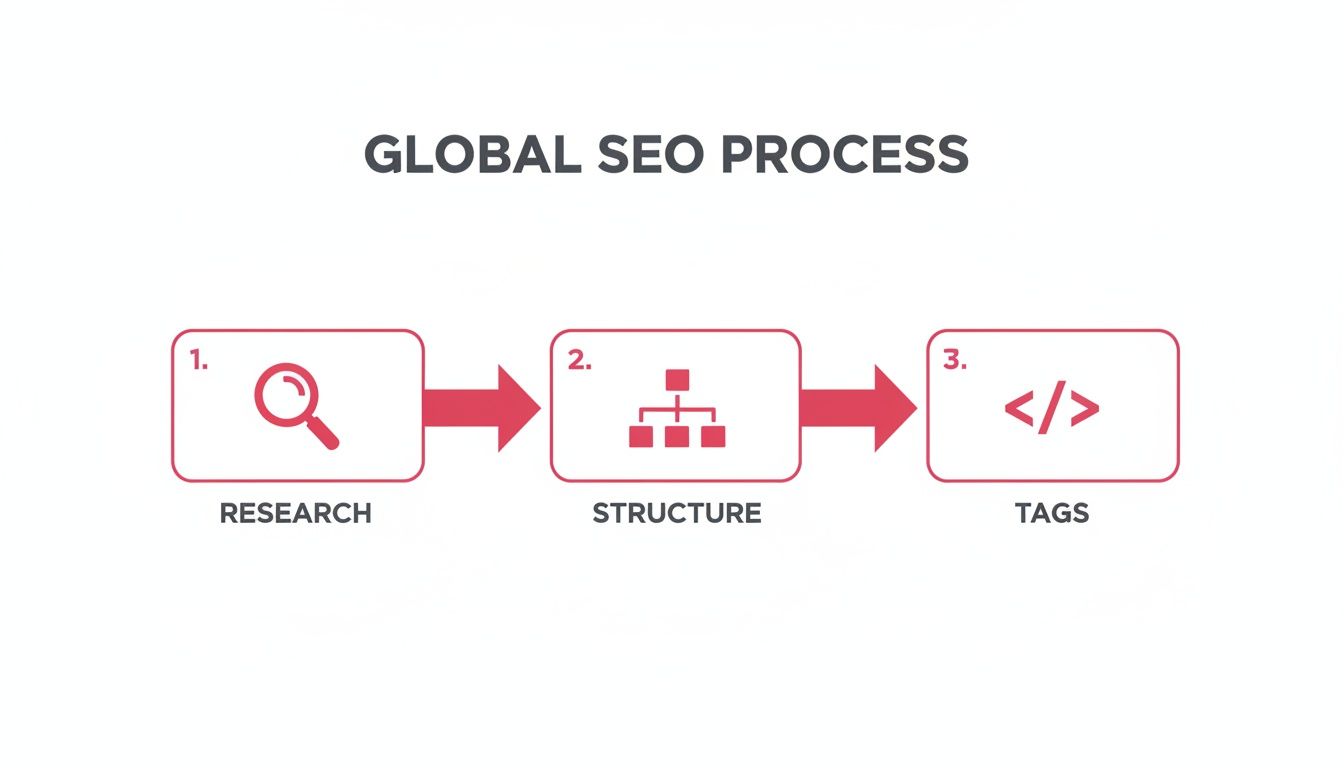
As you can see, smart localization starts with research and a solid site structure before you get to the technical bits.
The WordPress Localization Workflow
Once you’ve got your plugin installed and ready to go, the actual process of localizing your site follows a pretty clear, repeatable path. Having a structured workflow like this ensures you don’t miss anything and that the experience feels polished for every single visitor.
Here’s what that looks like, step-by-step:
- Initial Language Setup: First things first, head into the plugin settings and add your target languages. This sets up the underlying site structure for each new language version.
- Automated Content Translation: Now for the fun part. Use the bulk translation feature to run all your existing posts, pages, and products through the AI. In a matter of minutes, you’ll have a complete, translated baseline to work from.
- Review and Refine: This step is absolutely critical for quality. Go through the AI-generated text, paying special attention to your most important pages. This is where you’ll fix awkward phrasing, adjust idioms, and make sure the tone is a perfect match for the local market.
- Localize Non-Text Elements: It’s not just about words. Look at your images, videos, and graphics. Do they make sense culturally? You might need to swap out stock photos or create new visuals that truly connect with the local audience.
- Adapt Functional Components: Don’t forget the small details. Update currency symbols in WooCommerce, check that date and time formats are correct, and make sure any contact forms or phone numbers are right for the region.
This systematic approach makes the entire project feel much less overwhelming.
Your WordPress Localization Checklist
To make sure nothing slips through the cracks, a simple checklist is your best friend. It helps you keep track of all the moving parts and guarantees a professional result.
- Content: Have all posts, pages, and custom post types been translated and reviewed?
- SEO: Are meta titles, descriptions, and URL slugs fully localized? Have you double-checked your hreflang tags?
- E-commerce: Are product descriptions, prices, currencies, and payment gateways all set for the local market?
- Media: Have you culturally adapted your images, videos, and any downloadable files?
- Navigation: Are all your menus, widgets, and footer links translated and pointing to the right places?
- Legal: Is your privacy policy and terms of service updated to comply with local laws?
By following this framework, you can turn your single-language site into a true multilingual powerhouse. For a more detailed walkthrough, check out our guide on how to translate a page in WordPress. This methodical approach is your ticket to connecting with a much wider audience.
Avoiding Common Localization Mistakes
Even with a great plan, the road to a global audience has plenty of potholes. Knowing what localization is and actually pulling it off are two very different things. If you want your content to feel genuinely adapted, not just translated, you have to sidestep a few common traps.
One of the biggest blunders is trusting raw, unedited machine translation. AI tools are fantastic for getting a first draft, but they often stumble over cultural nuances, brand-specific terms, or industry jargon. This can leave you with messaging that’s awkward, unprofessional, or just plain wrong, which is a surefire way to lose a visitor’s trust.
Another classic mistake is ignoring regional dialects. The Spanish spoken in Madrid is a world away from the Spanish you’ll hear in Mexico City. Taking a one-size-fits-all approach to a language can make huge segments of your audience feel like you just don’t get them.
Overlooking Visual and Functional Details
You can have perfectly translated text, but if the user experience is clunky, you’ve already lost. Many businesses pour all their energy into words and forget about the non-textual elements that are just as crucial for making a real connection.
Here are a few things that often get missed:
- Culturally Insensitive Imagery: Using photos with people, gestures, or symbols that don’t resonate with the local culture—or worse, have negative meanings.
- Incorrect Formatting: Forgetting to switch to local formats for dates, times, currencies, and measurements. This small detail creates instant friction.
- Ignoring Media Content: Leaving video subtitles, voice-overs, or text within graphics untranslated. This makes a huge chunk of your content useless to a local audience.
A successful localization effort leaves no stone unturned. Every single element, from the smallest currency symbol to the main hero image, must be seen through a cultural lens to create a truly seamless and native experience.
The Cost of Poor Adaptation
These aren’t just minor slip-ups; they have real consequences for your business. They can tarnish your brand’s reputation, torpedo your SEO in local markets, and lead to a direct loss in sales. The entire media world is shifting to meet this need for deeper adaptation. The global Media Localization Services Market was valued at USD 13 billion in 2025 and is projected to hit USD 32 billion by 2033. This growth, detailed in this analysis of the media localization market, shows that businesses must adapt the entire experience, from text to video, to compete globally.
The best way forward is to combine the efficiency of AI with the critical eye of a human reviewer. For a closer look at how these technologies stack up, check out our guide on OpenAI versus Google Translate for website translation. A solid review process is your best defense against letting these mistakes go live.
A Few Common Questions About Localization
As you start planning your global expansion, a few questions always seem to pop up. Getting straight answers to these will help you sort out the final details and launch with confidence. Think of this as the FAQ section for taking your brand international.
Let’s break down some of the most common things people ask when they first dive into localization.
What Is the Difference Between Localization and Internationalization?
Let’s use a simple analogy: building a house.
Internationalization (i18n) is like designing the blueprint and laying the foundation. You’re building the house with a flexible electrical grid and universal plumbing hookups, knowing you might need to install different types of outlets or faucets later on. It’s the architectural work that makes future changes easy.
Localization (l10n) is the process of actually finishing a room for a specific resident. It’s installing the 220-volt outlets for someone moving from Germany, putting in the right bidet for a family from Japan, or painting the walls in colors that resonate in Brazil.
In short, internationalization is the prep work that makes your product adaptable; localization is the act of adapting it for a specific market.
How Much Does Website Localization Cost?
This is the classic “it depends” question, but the range has changed dramatically. Traditionally, you paid per word for human translation, which could get incredibly expensive, especially for a site with thousands of words across multiple languages. That old model made true localization feel out of reach for many businesses.
Today, AI-powered tools have flipped the script. Solutions that connect to APIs from services like OpenAI or Google Gemini can handle the initial heavy lifting of translation, slashing both the time and the cost. This makes a sophisticated global strategy accessible to almost everyone, though you’ll still need to budget for things like redesigning graphics or reviewing legal disclaimers.
A smart approach is using an integrated AI translation plugin that lets a human review and tweak the output. You get the speed and savings of automation, plus the critical quality control you need to protect your brand’s voice.
Can I Just Use Google Translate for My Website?
While a tool like Google Translate is a lifesaver for quickly understanding a foreign email, putting it in charge of your professional website is a huge gamble. It’s a machine, and it often misses the subtle nuances that define your brand’s personality.
It can get industry jargon wrong, fail to pick up on cultural sensitivities, and produce text that just sounds… off. These little mistakes can create a confusing or even unprofessional impression, eroding trust and turning potential customers away before they even get to know you.
Ready to make your WordPress site truly global without the manual overhead? EPIC WP Solutions offers AI-powered plugins that translate your entire site in minutes, not months. See how our tools can accelerate your international growth at https://www.epicwpsolutions.com